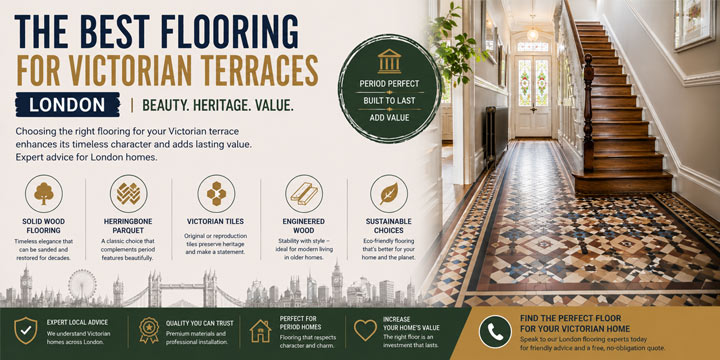
London's Victorian terraces present a genuinely distinctive set of challenges and opportunities when it comes to flooring. Suspended timber subfloors, original floorboards, period proportions, and the specific acoustic and thermal character of these buildings all shape what actually works well.
Understanding Your Victorian Terrace Subfloor
Most Victorian terraces have suspended timber ground floors, joists spanning between sleeper walls with air circulating beneath, and upper floors built similarly. This construction genuinely affects which flooring products perform well and which cause problems down the line.
Subfloor movement matters more than people expect. Suspended timber subfloors move seasonally, expanding in summer as humidity rises, contracting in winter as central heating dries the air. Any flooring installed here needs to accommodate that movement. Rigid, fully bonded flooring can crack or lift, while floating installations with proper expansion gaps around the perimeter are considerably more forgiving.
Ground-floor moisture is a real, specific risk. Ground-floor rooms can be susceptible to moisture rising from the ground beneath. Before installing any wood flooring, check the condition of the ventilation beneath the floor, the airbricks visible on exterior walls, and consider a proper moisture survey. High moisture levels cause cupping and deformation regardless of how well a floor is fitted.
The Case For Original Floorboards
Many Victorian terraces still have original pine floorboards in place under later carpet. These boards, typically 22mm to 25mm solid pine, are a genuine asset. Before spending on new flooring, it's worth lifting a corner of carpet to see what's actually underneath.
Boards in good condition can often be sanded and finished for roughly £20 to £35 per m², for straightforward work on boards without significant damage, meaningfully less than new flooring would cost. They also carry a character and authenticity manufactured products simply can't replicate. In a period property, original boards are genuinely a selling point new LVT or engineered wood can't match.
Best New Flooring Options, If Original Boards Aren't Viable
Where boards have been cut, damaged, or compromised by previous work, here's what tends to work best instead:
- Engineered oak is the most widely fitted new flooring in Victorian terraces. Its plywood construction handles suspended timber subfloor movement better than solid wood, while the real oak wear layer keeps an authentic appearance. Boards at least 18mm thick with a 3mm to 4mm wear layer perform well long-term, and wider boards (180mm to 220mm) look proportionally right in the larger rooms Victorian houses tend to have.
- Solid hardwood, particularly oak, ash, or walnut, suits Victorian terraces well aesthetically, but genuinely needs a stable, dry subfloor and isn't compatible with underfloor heating. On upper floors of a well-maintained terrace it's a genuine premium choice; on ground floors with any moisture concern, engineered wood is the safer option.
- Encaustic and geometric tiles are the defining feature of many Victorian hallways. If an original tiled hallway is missing or damaged, suppliers like Original Style and Fired Earth offer genuinely period-appropriate replacement patterns. This is rarely a DIY-friendly job, original Victorian patterns need careful planning and experienced tile-laying specifically.
What Genuinely Doesn't Work In A Victorian Terrace
A few choices that work well in modern properties are poorly suited here:
- Ceramic or porcelain tiles directly over suspended timber floors, the natural flex in the subfloor cracks grout and eventually the tiles themselves.
- Thin LVT without proper subfloor preparation, any existing unevenness telegraphs straight through the surface.
- Fully bonded solid wood on ground floors with real moisture concerns.
- Very high-gloss finishes, which tend to look incongruous against period proportions and show every footprint.
Conservation Areas And Listed Buildings
Large parts of inner London's Victorian housing stock sit within conservation areas, which generally doesn't restrict internal flooring choices. If your property is listed, or subject to an Article 4 direction, it's worth checking with your local council's conservation officer before making major changes to original fabric, tiled hallways or parquet floors specifically.
Flooring For Victorian Terraces: Common Questions
Should I keep original floorboards or replace them with new flooring?
If they're in reasonable condition, restoring them is generally the better route, both financially and for the character they add, a genuine asset new flooring can't replicate.
Is solid or engineered wood better for a Victorian terrace?
It depends on the floor level. Solid wood suits stable, dry upper floors well, while engineered wood is the safer choice for ground floors with any moisture concern, thanks to its more stable construction.
Why can't I put ceramic tiles directly over my suspended timber floor?
The natural seasonal flex in a suspended timber subfloor will eventually crack both the grout and the tiles themselves, which is why this combination genuinely doesn't hold up long-term.
Do I need council permission to change flooring in a conservation area?
Generally not for internal flooring, but listed buildings or properties under an Article 4 direction should check with the local conservation officer before altering original fabric like tiled hallways or parquet.
Call us on 020 7036 0625 or request a free site visit — we work regularly with Victorian terraces across London and can advise on the right approach for your specific property.